
Choosing an industrial heater is not simply a matter of picking the highest wattage, or the type your supplier sells the most of. The right heater depends on what you are actually trying to heat, how heat needs to reach that object or material, and the conditions the heater has to survive in.
Get the selection wrong and the result is usually one of a few familiar problems: uneven heating, premature failure, a heater that doesn’t fit the available space, or a control system that’s harder to tune than it should be.
Before specifying an industrial heater, it helps to work through a short list of questions:
- What exactly needs to be heated?
- How should heat be transferred — by direct contact, immersion, or radiant heating?
- What are the operating conditions — temperature, environment, duty cycle?
- How much space is available for the heater and its wiring?
- What are the electrical requirements — voltage, wattage?
- How will the heater be mounted or installed?
- Does the process need temperature measurement and control?
- Is a standard heater size workable, or does the application need something custom-built?
This guide walks through each of those questions and explains how they narrow down the right type of industrial heater for your application.
Start With the Heating Application
Before comparing heater types, start with a simpler question: what exactly needs to be heated? Industrial heating elements are generally built around the shape and nature of what they’re heating, not the other way around. A few common categories:
- Cylindrical surfaces — barrels, pipes, nozzles, and other round components
- Moulds and dies — where heat needs to be introduced at a specific, often drilled, location
- Flat or curved surfaces — platens, panels, and ducts
- Liquids — tanks, vessels, and process fluids that need immersion heating
- Air or gases — ducted air heating or process gas heating
- Objects or surfaces that need direct, contactless heating, where radiant heat is more suitable than a heater in physical contact with the part
Once you know which of these categories your application falls into, you’ve already ruled out most of the heater families that wouldn’t work, and narrowed the search to the ones that will.
Match the Heater Type to the Application
Each heater family below is built around a different way of transferring heat. The right one depends on the application category identified above.
Cartridge Heaters
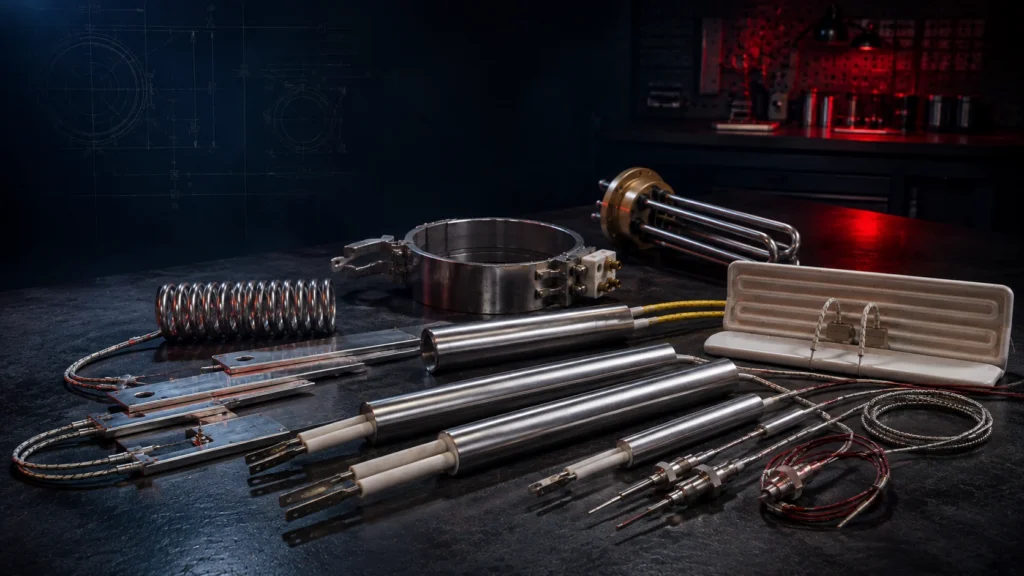
Cartridge heaters are cylindrical heating elements designed to be inserted directly into a drilled hole in a metal component, sitting in intimate contact with the surrounding material and heating it from the inside.
This makes them well suited to localized, high-density heating: moulds and dies, injection moulding tooling, sealing, drying equipment, and liquid heating where the heater is mounted directly into the vessel wall. Because they’re installed into an existing component, dimensions — length, diameter, and lead configuration — usually need to match that component closely.
See Swiftheat’s Cartridge Heaters range for available configurations.
Band Heaters
Band heaters wrap around a cylindrical surface — barrels, pipes, nozzles, and containers — and clamp into place rather than being inserted into the component. They’re a practical choice wherever the surface being heated is round and accessible from the outside.
Two common insulation types are used depending on the application: mica insulation, which offers high thermal conductivity, and ceramic insulation, which suits higher-temperature use. Some band heaters also need a thermocouple hole for direct temperature sensing at the band itself.
Explore Swiftheat’s Band Heaters for barrel, pipe, and nozzle heating.
Coil Heaters
Coil heaters use a compact spiral form, wound from high-resistance wire, designed to maximise surface-area contact in a small footprint. That makes them a natural fit for hot runner systems, injection moulding nozzles, and extrusion equipment, where space around the heated component is limited but fast, even heat-up is still required.
Because of their compact form, coil heaters are usually built to the specific dimensions of the nozzle or component they’re heating, rather than supplied as a generic size.
See Swiftheat’s Coil Heaters for nozzle and hot runner applications.
Strip Heaters
Strip heaters are flat or gently curved industrial heating elements used for surface heating on platens, dies, ovens, and air ducts. A few variants are available depending on the application: fin strip heaters, for increased surface area and convective heat transfer; ceramic strip heaters, for higher-temperature use; and clamp-on strip heaters, which mount without drilling into the surface.
Because strip heaters sit against a surface rather than being embedded in it, mounting method is often as important a selection factor as wattage.
See Swiftheat’s Strip Heaters for flat and curved surface heating.
Tubular Heaters
Tubular heaters are among the most versatile industrial heating elements, available in configurations for immersion heating in liquids, air heating, and general process heating. The same basic tubular form can be built as a standard or flexible element depending on the space and shape of the application.
Because tubular heaters can be immersed directly in liquid, mounted for air heating, or built into process equipment, construction needs to suit the specific operating environment — not just the temperature, but what the heater is actually in contact with.
See Swiftheat’s Tubular Heaters for liquid, air, and process heating.
Ceramic IR Heaters
Ceramic infrared heaters work differently to the heater types above. Rather than transferring heat through direct contact or immersion, they emit long-wave infrared radiation that heats the target object or surface directly, without needing to heat the surrounding air first.
That makes them useful for drying, curing, and forming applications, where direct, contactless heating is preferable to conduction. Because there’s no fan or air movement involved, they’re also relevant where dust or airflow around the process is undesirable.
See Swiftheat’s Ceramic IR Heaters for infrared drying, curing, and forming applications.
For a full comparison across all six families, browse Swiftheat’s complete range of industrial heating products.
Consider the Key Heater Specifications
Once the heater family is identified, the next step is defining the specification. At minimum, an industrial heater manufacturer will usually need:
- Wattage — how much heat output the application requires
- Voltage — matched to your available electrical supply
- Dimensions — length and diameter for cartridge, coil, and tubular heaters; overall size for strip and band heaters
- Sheath or surface material — matched to the operating environment
- Mounting requirements — how the heater attaches to or installs into the component
- Lead and terminal configuration — including any lead protection needed, such as a braided sleeve, silicone coating, fiberglass sleeve, or armor, depending on the environment
- Operating environment — temperature, exposure to liquids or chemicals, vibration
- Available installation space — particularly important for coil and cartridge heaters going into existing components
- Control and sensing requirements
None of these should be guessed. The correct wattage for one application can be entirely wrong for another of similar physical size — it depends on heat loss, the mass being heated, and how quickly it needs to reach temperature. That’s exactly why industrial heater selection should start with the application, not the catalogue number.
Don’t Ignore Temperature Measurement and Control
A heating element only does half the job. In most industrial processes, something also needs to measure temperature so the heater can be controlled accurately, rather than left running open-loop.
Temperature sensing is typically done with a thermocouple or an RTD (resistance temperature detector). RTDs offer higher stability and accuracy compared with thermocouples, which is why they’re often specified in applications where precise, repeatable temperature control matters.
Swiftheat’s Temperature Sensors range is built around RTD types — PT100, PT500, and PT1000 — supplied with the connectors needed to integrate them into your control system.
Not every heating application needs a dedicated sensor built into the same system — some processes rely on existing plant instrumentation — but where accurate, closed-loop control matters, sensor selection deserves the same attention as heater selection.
When a Standard Heater Is Not Enough
Many industrial heating applications can be served by a heater built to standard dimensions. But a standard size doesn’t always exist for a given application, particularly when:
- The component being heated has unusual dimensions
- Space for the heater is limited or oddly shaped
- Mounting needs to match an existing bracket, flange, or drilled hole
- Wattage or voltage needs to match a specific electrical supply rather than a common rating
- The leads need particular protection for the operating environment
- An imported or obsolete heater needs to be replaced, and the original manufacturer’s part is no longer available
This is where custom heater design becomes relevant. Swiftheat works from a customer’s drawing, a physical sample, or simply a description of the application and the problem it needs to solve, including reverse-engineering a heater to replace an existing or imported part. Wattage, voltage, dimensions, sheath material, terminal configuration, and mounting can all be built around the specific application rather than fitted to a generic size.
Quality and Testing Matter
An industrial heater that fails early, or fails without warning, is expensive well beyond the cost of the part itself: downtime, damaged product, and in some cases safety risk. Testing before dispatch is what catches a faulty heater before it reaches your process rather than after.
At Swiftheat, every heater is individually tested before it leaves the facility, not sampled from a batch. Testing typically includes:
- Insulation resistance testing
- High-voltage (dielectric) testing
- Dimensional and visual inspection
- Performance verification, where applicable
Each heater is supplied with its own test report, giving traceability back to that specific unit rather than a general batch reference. For applications with more demanding documentation requirements, supporting paperwork — including material test certificates where applicable, inspection reports, and traceability records — can also be provided.
Testing doesn’t replace correct selection in the first place, but it’s the last check that confirms the heater you’ve specified actually performs the way it’s meant to before it’s installed.
What Information Should You Provide When Requesting a Heater?
Whichever heater type your application points to, gathering the right information before contacting a manufacturer will get you an accurate quote and the right heater faster. A practical checklist:
- What are you heating — a component, liquid, air, or surface?
- What heater type or installation arrangement are you currently using, if any?
- Required wattage and voltage, if known
- Required dimensions — length, diameter, or overall size
- Operating temperature
- The material and environment the heater will be exposed to
- Mounting method
- Lead and terminal requirements
- Whether temperature sensing or control is needed
- A drawing, sample, photograph, or details of an existing heater, if you have one
You don’t need every answer before making contact. Even a photo of the component or a sample of the existing heater is often enough for an engineer to start narrowing down the right specification.
Choosing the Right Industrial Heating Solution
There’s no single industrial heater that’s correct for every application. The right choice depends on what’s being heated, how heat needs to reach it, the dimensions and electrical requirements involved, the environment the heater has to survive in, how it will be installed, and whether the process needs temperature sensing and control alongside it.
For applications that fit an existing standard configuration, that’s usually the fastest and most economical route. For applications that don’t — unusual dimensions, specific mounting needs, or a heater that has to match an existing component exactly — a custom-built heating solution is often the more practical answer than trying to adapt a standard part.
Swiftheat designs and manufactures cartridge, band, coil, strip, and tubular heaters, ceramic IR heaters, and RTD temperature sensors, working from drawings, samples, or a description of the application when a standard product doesn’t fit. Every heater is tested before dispatch, with a test report supplied for traceability.
Need Help Selecting the Right Industrial Heater?
Share your application with Swiftheat’s engineering team — a drawing, a sample, a photo of an existing heater, or simply a description of what needs to be heated. Talk to the team to discuss your requirements or request a quote.